Training Conducted within the “Technologies of Active STEAM Learning” Course
.png)
At Karazin University, lecturers immersed themselves in a training programme where the key question was not “What should we teach?” but rather “How can we create a learning experience in which a student thinks simultaneously as a researcher, an engineer, and a creator?”
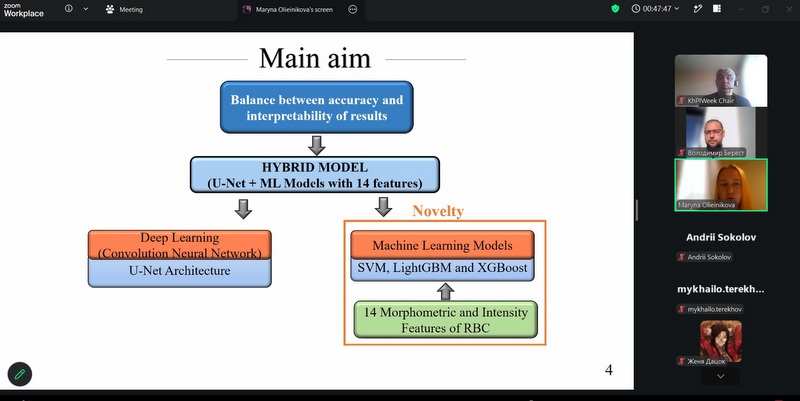
From 12 to 26 May 2026, a training course entitled “Technologies of Active STEAM Learning” was held. The programme was designed to develop competencies for implementing STEAM education through active learning, inquiry-based methods, the use of digital tools, and artificial intelligence. It served as a kind of educational accelerator where lecturers designed a new logic of teaching and learning.
.png)
Course speakers:
• Natalia Morze — Professor, Corresponding Member of the National Academy of Educational Sciences of Ukraine, Professor at the Department of Innovative Pedagogy, Educational Transformations and Leadership of the Education and Research Institute “Academy of Teacher Education” at V. N. Karazin Kharkiv National University, and Head of Educational and International Projects.
• Mariia Boiko — Associate Professor at the Department of Innovative Pedagogy, Educational Transformations and Leadership of the Education and Research Institute “Academy of Teacher Education” at V. N. Karazin Kharkiv National University, and Head of Educational and International Projects.
The training combined theoretical sessions, discussions, practical exercises, analysis of pedagogical case studies, and group work. The main focus was on transforming students’ learning activities: helping them investigate, ask questions, work with data and evidence, model solutions, justify their positions, and collaborate effectively.
The programme consisted of five thematic modules:
Module 1. “Evidence-Based STEM Learning and the Development of Scientific Thinking”
This module focused on the principles of effective research-based STEM education. Participants explored ways to develop students’ scientific, inquiry-based, and computational thinking, as well as methods for integrating active learning approaches into teacher education. Lecturers examined how evidence-based STEM learning works in practice: how to transform a lecture into an investigation and a student into the author of hypotheses.
Module 2. “Pedagogical Approaches to STEM Learning”
The module concentrated on inquiry-based learning, project-based learning, and design thinking. Participants analysed how these approaches can be applied in higher education and how they contribute to the creation of interdisciplinary learning activities connected to real-world challenges.
Module 3. “Digital Tools for Supporting STEM Learning”
This module focused on the use of digital technologies in education. Simulations, interactive platforms, modelling, and visualisation transform learning into an environment for experimentation. Education becomes a “digital testing ground” where learners can test hypotheses, model phenomena, and make the invisible visible. Participants explored the potential of simulations, virtual laboratories, modelling tools, data visualisation, collaborative technologies, and formative assessment instruments.
Module 4. “Course Design and Assessment of STEM Competencies”
The module aimed to develop an understanding of the relationship between learning outcomes, learning activities, and assessment. Participants examined examples of competency-based STEM tasks, assessment criteria, and approaches to improving their own courses and learning activities. Lecturers considered the possibility of designing courses backwards: first defining learning outcomes, then selecting activities, and only afterwards determining assessment methods.
Module 5. “Artificial Intelligence in STEM Education”
This module addressed the opportunities and challenges associated with the use of AI in education. Special attention was given to the role of artificial intelligence not as a replacement for educators but as a tutor, a thinking assistant, and a tool for critical analysis. At the same time, AI presents challenges to academic integrity and requires a new culture of learning responsibility. Participants discussed the responsible use of AI tools, academic integrity, the role of AI as a tutor, an assistant for analysing educational tasks, and a simulator of complex STEM-related situations.
Final Course Outcome
Each participant develops an individual mini-project or a course component that incorporates active learning, STEAM principles, digital tools, and future-oriented thinking.
The online training served as a preparatory stage for further practical work. The next step will be a Summer School, during which participants will have the opportunity to deepen the ideas they have developed, collaboratively design and test their own STEM projects or learning activities, and present their pedagogical solutions to colleagues.

.jpg)
.jpg)
.png)