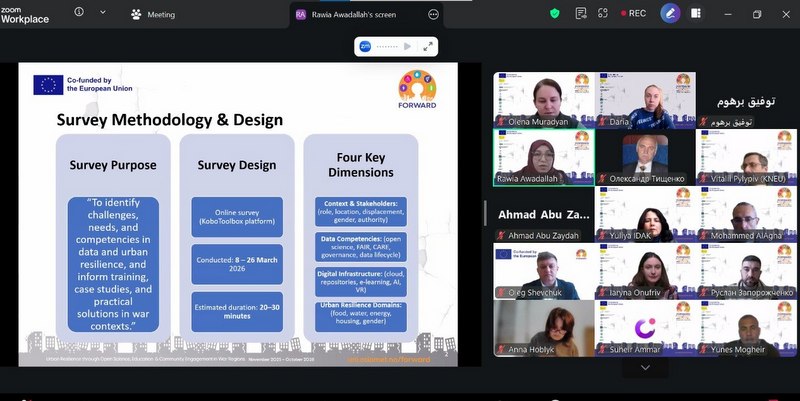
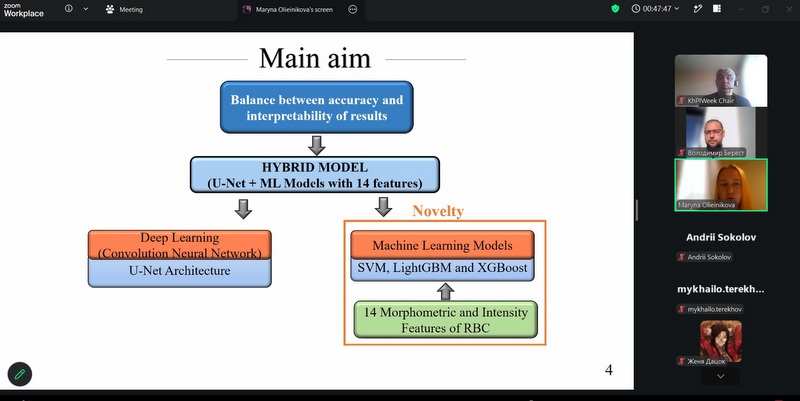
On April 23, 2026, as part of the international project “FORWARD — Urban Resilience through Open Science, Education, and Community Engagement in War Regions,” the first online workshop titled “Open Science and Urban Resilience in War-Affected Regions: Challenges and Pathways for Sustainable Recovery” was held.
The event brought together representatives of the academic community, civil society, municipalities, and experts in urban development, infrastructure, open science, and community resilience in war-affected regions.
The FORWARD project is being implemented at the Department of Political Sociology of the Education and Research Institute of Sociology and Mass Communications.
The organization and delivery of the workshop involved Olena Muradyan, Director of the Education and Research Institute of Sociology and Mass Communications, as well as representatives of the Department of Political Sociology: Senior Lecturer Daria Yashkina and Associate Professor Ruslan Zaporozhchenko. They moderated the Ukrainian panel, delivered presentations, participated in discussions, and commented on key issues raised during the session.
Participants from Lviv Polytechnic National University and Kyiv National Economic University named after Vadym Hetman also joined the event.
The aim of the workshop was to discuss preliminary research results within Work Package WP2, gather expert assessments from stakeholders, and identify key needs for the further development of educational, research, and digital solutions in the field of urban resilience.
More than 100 participants joined the workshop overall, with over 40 participants contributing to the discussion in the Ukrainian panel, demonstrating strong interest in urban resilience, sustainable recovery, and the role of universities in supporting communities in crisis conditions.
Participants worked in two parallel language panels — Ukrainian and Arabic — allowing for consideration of diverse local contexts, experiences, and challenges in Ukraine and Palestine.
During the Ukrainian panel, a substantive discussion took place around four key areas of urban resilience: water resource management, food security, energy sustainability, and housing and shelter.
Participants discussed whether the initially identified challenges reflect the real needs of communities, which issues remain underestimated, and which competencies, infrastructure solutions, and learning formats are most needed for professionals, researchers, local authorities, and civil society organizations.
Special attention was given to FAIR data, open science, digital infrastructure, gender sensitivity, and inclusiveness in recovery processes. These approaches are essential for developing evidence-based solutions, fostering effective cross-sector collaboration, and ensuring responsible data use in crisis and post-crisis contexts.
The workshop was not only presentation-based but primarily dialogue-driven and practice-oriented.
Participants actively engaged not just in listening to presentations but in jointly defining priorities: identifying the most pressing challenges, knowledge and skills gaps, and digital tools that can strengthen research, governance, and community recovery. The outcomes of these discussions will form the basis for further work within the FORWARD project, including the development of strategic recommendations, educational modules, and priorities for digital infrastructure and open science.
We thank all participants of the Ukrainian panel for their active engagement, professionalism, openness to dialogue, and willingness to collaboratively seek solutions for a more resilient, safe, and inclusive future.
The project is funded by the European Commission under the Erasmus+ programme. The views and opinions expressed in this publication are those of the author(s) and do not necessarily reflect the views of the European Union or the European Education and Culture Executive Agency (EACEA). Neither the European Union nor the funding body can be held responsible for them.




.jpg)
.jpg)
.png)