Five Myths About Admission to Ukrainian Educational Institutions for Young People from Temporarily Occupied Territories
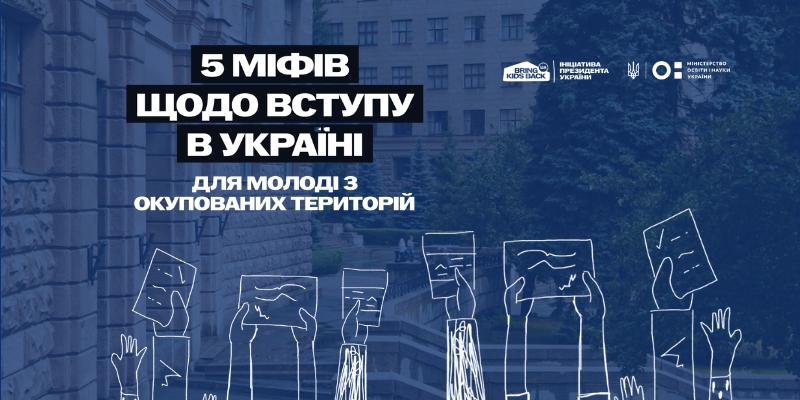
Applying to a Ukrainian educational institution can often be a source of anxiety and uncertainty for young people from the temporarily occupied territories. A lack of reliable information gives rise to myths that may seem like serious obstacles to pursuing higher education. In reality, Ukrainian higher education institutions have introduced a range of support mechanisms to make the admission process accessible and safe.
Myth 1. Insufficient proficiency in Ukrainian may result in being denied admission
Proficiency in the Ukrainian language is not a reason for refusing admission. Special admission conditions have been introduced for young people from the temporarily occupied territories, taking into account the consequences of prolonged separation from the Ukrainian educational environment. During their adaptation to university life, students can benefit from mentoring, tutoring support, and additional classes designed to help them integrate into the educational process comfortably.
Myth 2. Applying is unsafe because my name will be publicly displayed in the admission ranking lists
The safety of applicants is one of the top priorities. Confidentiality is a mandatory principle for organizations that assist young people in leaving the temporarily occupied territories. Moreover, when admission ranking lists are published, the surnames of these applicants are encoded to ensure anonymity and protect their personal data.
Myth 3. It is already too late to apply
Even if leaving the temporarily occupied territory during the main admission campaign is impossible, the opportunity to apply remains available. Additional admission mechanisms are provided, including an extra session of the National Multi-Subject Test (NMT). In addition, interviews may be conducted remotely at the decision of the admissions committee. Coordination centres also play an important role by helping children and young people develop an individual reintegration plan and choose the most suitable educational pathway.
Myth 4. There will be nowhere to live after enrolment
Young people from the temporarily occupied territories have access to various accommodation options depending on their individual circumstances. These may include university dormitories, temporary shelters provided by non-governmental organizations, or social housing for young people aged 18 to 23. Each case is considered individually to ensure the most appropriate form of support.
Myth 5. Getting a state-funded place is almost impossible because of high competition
In fact, applicants from the temporarily occupied territories have additional opportunities to secure state-funded places. In particular, they are eligible for Quota-2, which provides simplified access to government-funded study places. Furthermore, the government has increased both the number of state-funded places and the amount of educational grants for a number of priority fields of study. These include education, natural sciences, mathematics and statistics, engineering, manufacturing and construction, agriculture, forestry and fisheries, veterinary medicine, transport, services, as well as security and defence.
Education remains accessible even under the most challenging circumstances. It is important to remember that most concerns about university admission stem from a lack of information. That is why prospective students are encouraged to rely on official sources and seek advice from admissions consultants, who can explain the admission procedure and help them take full advantage of the available support measures.


.jpg)
.jpg)
.png)