Germany’s Federal Foreign Minister Johann Wadephul Visits Karazin University
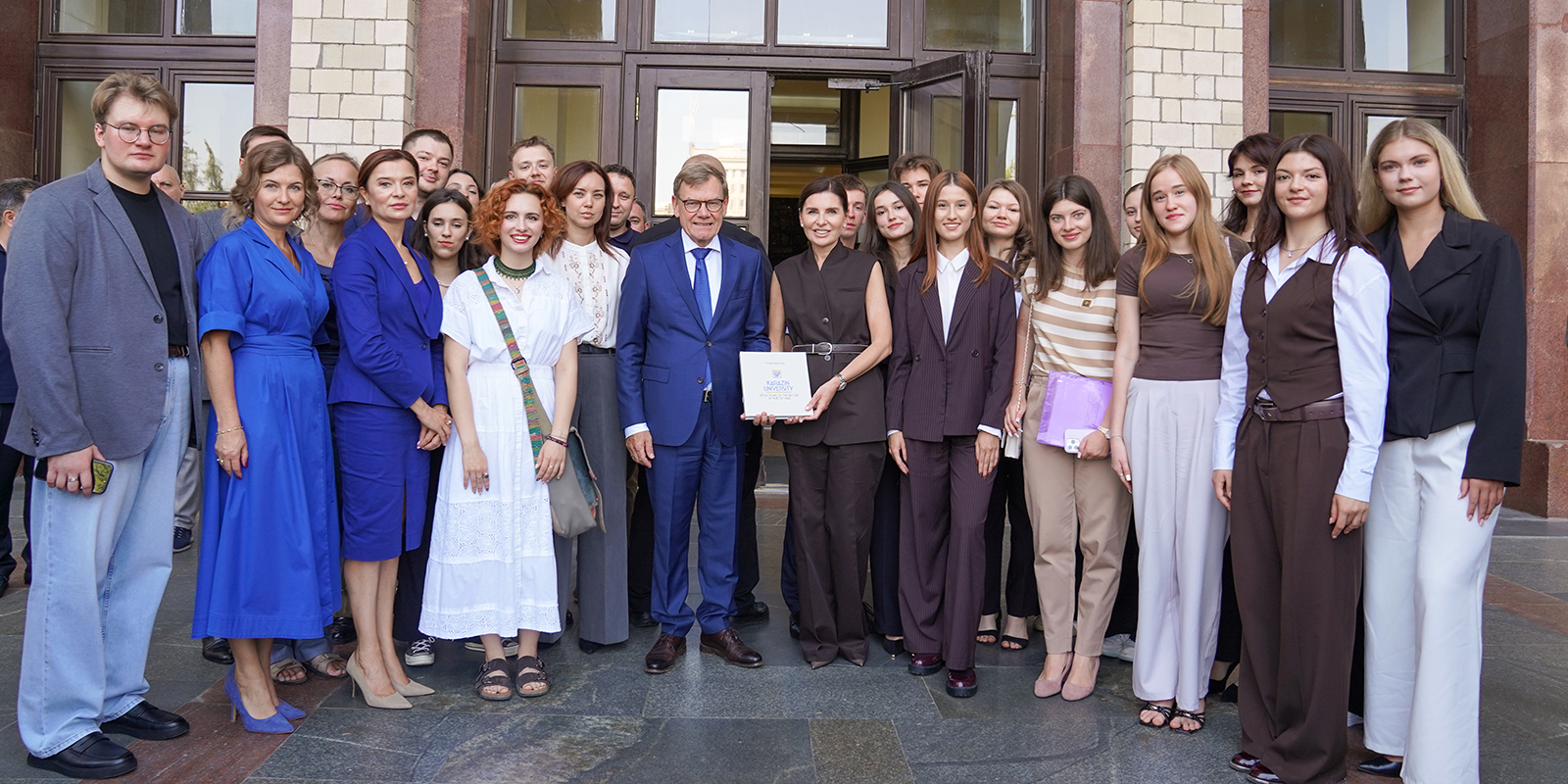
The Minister met with students and representatives of the university community. The meeting was also attended by Ambassador Extraordinary and Plenipotentiary of Germany to Ukraine Boris Ruge, Deputy Minister of Foreign Affairs of Ukraine Yevhen Perebyinis, and Honorary Consul of the Federal Republic of Germany in Kharkiv Tetiana Havrysh.
During his conversation with students, the Federal Minister paid particular attention to how university students view the educational process and their future amid the full-scale war. The discussion focused, in particular, on the organisation of education in Kharkiv and the gradual return of students to in-person learning through the development of safe educational infrastructure at Karazin University.
In the new academic year, the University plans to partially resume classroom-based learning in a specially equipped underground educational space with a radiation shelter.
“For us, studying offline will be a new experience. Students in Kharkiv see their future here. Despite all the problems and challenges caused by the war, we will do our best to overcome them,” said Viktoriia Besedina, a first-year student at the School of Foreign Languages.
Acting Rector of Karazin University Tetyana Kaganovska noted that around 2,500 students are expected to take part in classroom-based learning this year. She also emphasised that the University already has an extensive network of partnerships with the Federal Republic of Germany and continues to expand Ukrainian-German cooperation in education and research.
“Karazin University has an official representation and an educational centre in Munich, operating at the GOROD cultural centre. The project was established to enable Ukrainian students to receive high-quality, European-standard higher education even during the war. The educational centre combines Ukrainian academic programmes with European standards. Students have a unique opportunity to use modern research laboratories and the technological facilities of leading partner universities in the Federal Republic of Germany,” Tetyana Kaganovska said.
Another important topic of the meeting was strengthening mutual understanding and ties between Ukrainian and German societies. Johann Wadephul noted that a significant number of young Ukrainians are currently studying in Germany and that, after the war, these young people could play an important role in further developing bilateral relations.
“Of course, this is a bad reason, but because of the war, we have come to understand each other better,” Johann Wadephul said. According to him, many Ukrainian students are currently studying in the Federal Republic of Germany, and a significant proportion of them will return to Ukraine after the war. They could become an important bridge for further communication and the development of partnership between the two countries.
During his visit, Germany’s Federal Foreign Minister also learned about the scientific developments of Karazin University. In particular, he was presented with the work of a state-of-the-art bioprinter installed at the Karazin BioMed research laboratory of the Department of Biochemistry.
The bioprinter opens up new opportunities for students and researchers to create implants and tissue analogues, including skin, corneas, bone, and cartilage. Such developments can be applied in transplantation, reconstructive and regenerative medicine, traumatology, orthopaedics, cardiac surgery, and dentistry. The equipment is also used for research and testing new medicines.
Johann Wadephul’s visit to Karazin University provided another opportunity for direct dialogue with young people and for discussing the future of education, science, and Ukrainian-German partnership amid the war and Ukraine’s post-war recovery.


.jpg)
.jpg)
.png)