.png)
From 15 to 22 December 2025, the training programme “From Traumatic Experience to Peace: Resilience Tools for Ukrainian Educators” was held. It was implemented on the Karazin Peace Education HUB platform — an educational space created within the international Aurora 2030 initiative and co-funded by the European Union. The programme aimed to support teachers in general secondary education institutions amid prolonged war-related challenges and the growing psycho-emotional vulnerability of the educational environment.
The programme’s goal was to strengthen teachers’ psychological and emotional-ethical competence, develop their stress resilience, build the ability to respond mindfully to crisis situations, and integrate the principles of trauma-informed pedagogy into everyday educational practice. The programme was moderated by Olha Vyhovska, Director of the Education and Research Institute “Teachers’ Academy.”
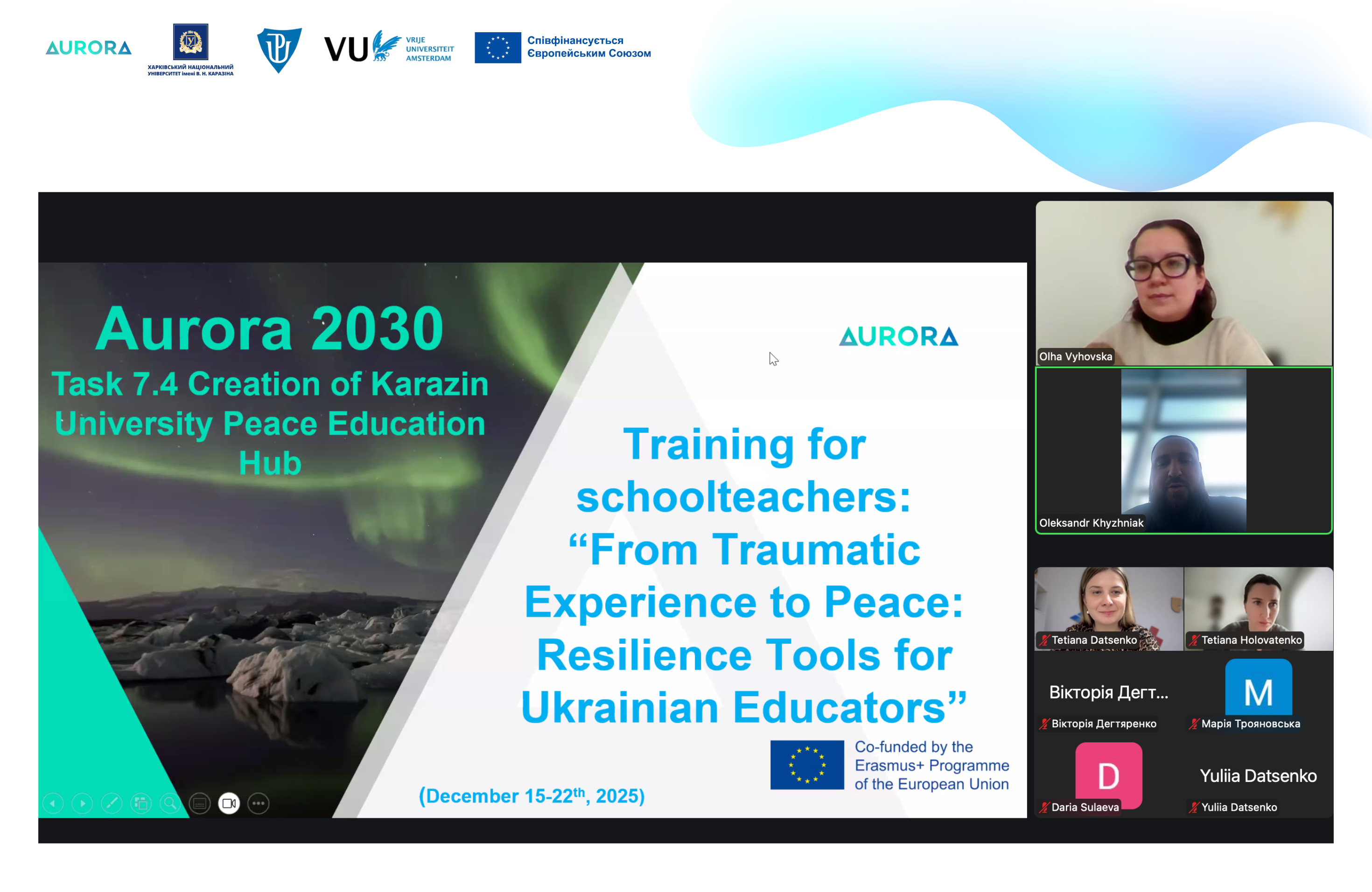
The programme opened with a presentation of the initiative delivered by Dr Oleksandr Khyzhniak, Coordinator of the VU Academic Freedom Program (the Netherlands). His talk outlined the international context of support for Ukrainian education and emphasized the role of educators as agents of recovery, resilience, and peacebuilding.
A key event was the panel discussion “Rethinking Resilience: Education as a Space for Healing and Recovery,” which brought together leading experts in the field. The discussion featured Liliia Hrynevych (V. N. Karazin Kharkiv National University), Oleksandr Elkin (EdCamp Ukraine NGO), and Halyna Tytysh (Vchysia NGO). The panel focused on rethinking the concept of resilience, the role of schools as spaces of support and recovery, and the responsibility of education in times of war. The international dimension was further strengthened by a lecture from Dr Selma Porobic (Palacký University Olomouc, Czech Republic) on the role of peace education in overcoming trauma caused by war violence.
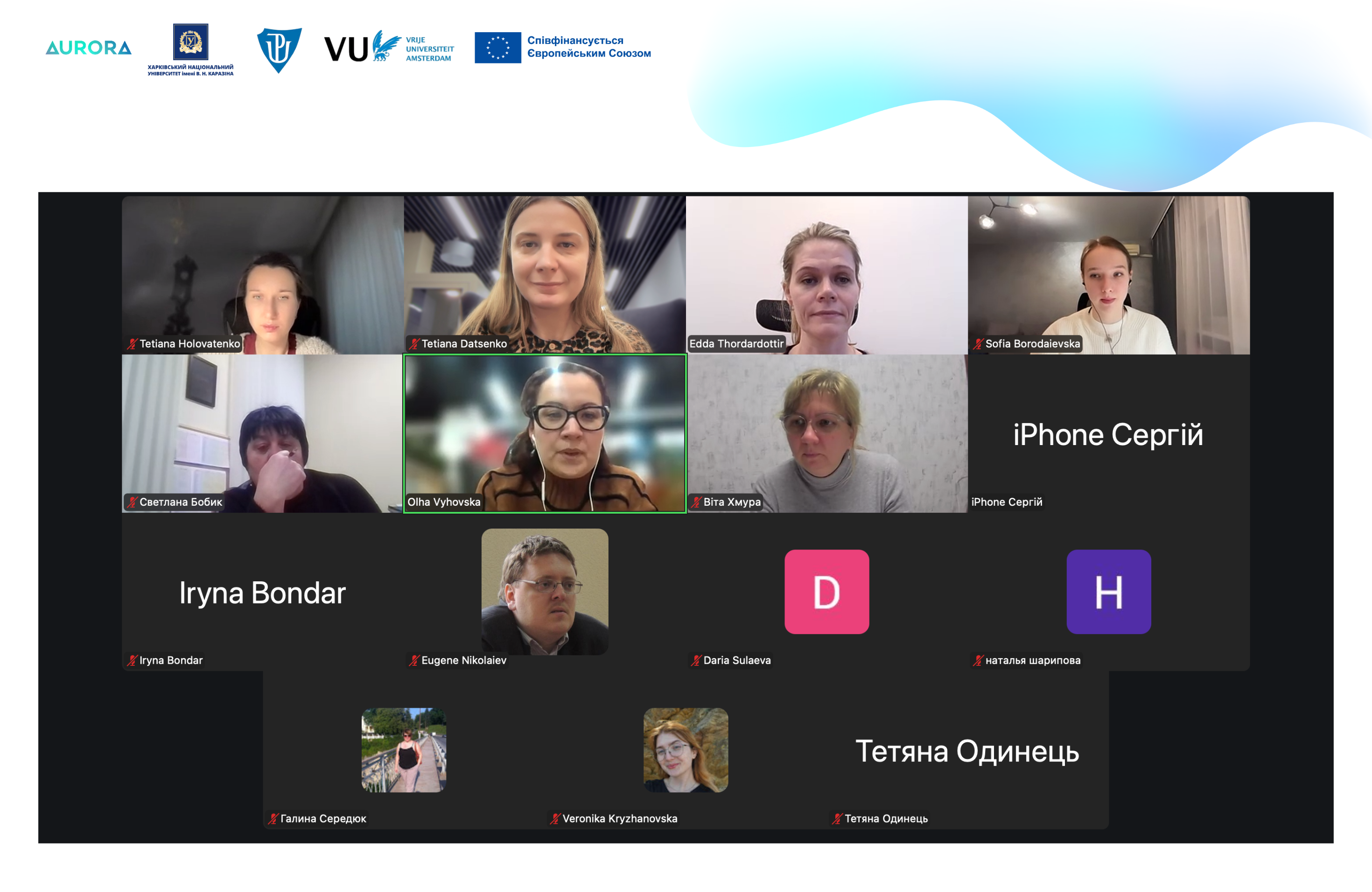
The training continued with a focus on practical aspects of the trauma-informed approach under the guidance of Tetyana Holovatenko (Education and Research Institute “Teachers’ Academy”) and Tetiana Datsenko (Education and Research Institute “Teachers’ Academy”). Participants explored ways to implement its principles in work with students, as well as issues of psychosocial support for educators as a necessary condition for professional resilience. Special attention was given to stress resilience in the educational space, with an emphasis on personal resources and self-regulation.
The programme concluded with a lecture by an international expert, Dr Edda Björk Tordardottir (University of Iceland), devoted to acute stress reactions and stress-related disorders in children and adults. The final session helped participants systematize their knowledge of physiological, emotional, and behavioural responses to trauma and understand the boundaries of safe responses within the educational environment.
.png)
Interpretation during the training sessions was provided by Olha Pieshkova, Deputy Director of the Education and Research Institute “Teachers’ Academy,” and Sofiia Borodaievska, a second-level Master’s student of the programme “Interpreting and Intercultural Communication” (School of Foreign Languages). Their work enabled full participant engagement in the international expert dialogue and the substantive activities of the programme.
In addition, throughout the programme, participants worked with learning materials and completed tasks for independent study, which contributed to deeper reflection on the topics and their practical application. In total, more than 40 educators from different regions of Ukraine registered for the training. Following the final certification test, teachers who successfully completed the programme received certificates worth 1 ECTS credit (30 hours), published on the educational platform: https://edway.ua/uk/mpk/1562/detail/.
Participants deepened their understanding of physiological, emotional, and behavioural reactions to stress and trauma, learned how to respond to them safely in the learning environment, provide psychosocial support, and strengthen their own resilience. An important outcome was a renewed understanding of education as a resource for recovery, support, and the development of a culture of peace. The programme became another step towards creating a safe educational environment in which teachers play a key role in the recovery and future of Ukrainian society.
.png)
.png)



.jpg)

.png)