


International Student Debates Held at Karazin University within the Hybrid Students’ ValEU’s Debating Hub
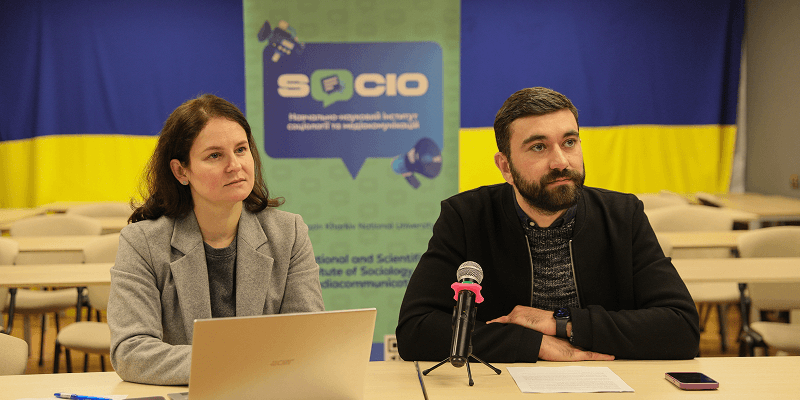
Within the framework of the Hybrid Students’ ValEU’s Debating Hub initiative, implemented as part of the international research project “ValEU’s – A Research and Education Network on Challenges to EU External Policy”, large-scale international student debates dedicated to current challenges to European values, democracy, and contemporary societies were held on 20 February 2026.
The debates were organized by the Department of Political Sociology of the Educational and Research Institute of Sociology and Media Communications of V. N. Karazin Kharkiv National University. The event was coordinated by the Director of the Institute, Olena Muradian, and Associate Professor of the Department, Ruslan Zaporozhchenko.
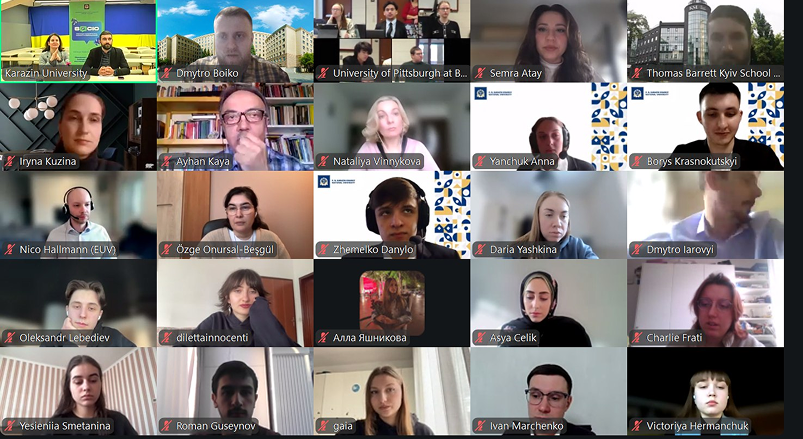
The event brought together more than 50 students from universities across Europe, Ukraine, North and Latin America, and Asia, creating a shared space for reasoned and meaningful dialogue. The debates were held in a hybrid format, combining online participation via Zoom with offline locations, which made it possible to engage a broad international audience and create a truly cross-border platform for the exchange of ideas. The main objective of the event was to foster a culture of democratic discussion, develop critical thinking, and enhance skills of reasoned argumentation with respect for opposing viewpoints.
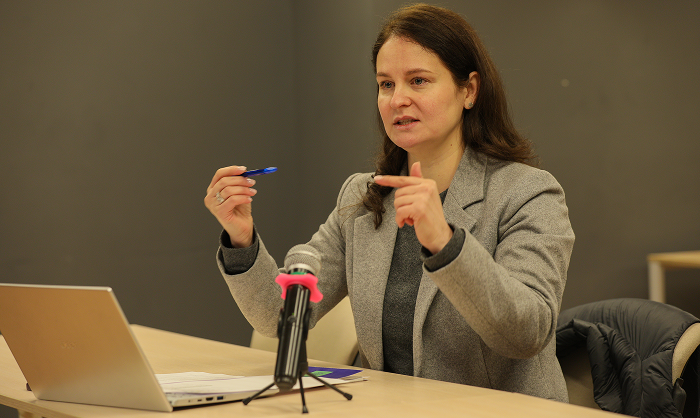
Before the debates began, the participants were welcomed by Olena Muradian, Director of the Educational and Research Institute of Sociology and Media Communications. She emphasized the importance of academic debates as a tool for developing critical thinking, a culture of dialogue, and a responsible attitude toward democratic values, especially in the context of today’s social and political challenges.
The participants were also greeted by the scientific coordinator of the ValEU’s project, Nico Gallmann, who highlighted the international character of the initiative and the importance of engaging students from different countries in discussions on European values. In his address, he noted that such formats contribute to the formation of responsible citizenship and a shared European space for dialogue. In addition, he thanked the team for their work and expressed solidarity and support for Karazin University, Kharkiv, and Ukraine during these difficult times of Russian military aggression.
The discussions were conducted using the Karl Popper debate format, which focuses not on competition but on rational analysis, testing arguments, and value-based reflection on positions. This approach corresponds to the philosophy of an open society and to European principles of pluralism, freedom of thought, and responsibility for one’s words. During the debates, six Zoom rooms operated in parallel, each hosting two teams discussing a separate topic, including:
-
Freedom or security: where is the boundary of European values?
-
European identity: myth, project, or reality?
-
Algorithms and democracy: do technologies control our choices?
-
Populism: a threat or a symptom of democracy?
-
Migration and tolerance: a test for Europe?
-
Cancel culture: freedom of speech or a new form of censorship?
The debates featured students from universities in Ukraine (Karazin University and Kyiv School of Economics), Turkey (Istanbul Bilgi University), Poland (Adam Mickiewicz University), Italy (University of Florence), the United States (University of Pittsburgh), Mexico (University of Guadalajara), Colombia (Universidad del Norte), and Kazakhstan (Nazarbayev University).
The teams represented diverse academic cultures and social contexts, which significantly enriched the discussions and made it possible to view common European challenges from multiple perspectives. In addition to the main speeches and cross-examination rounds, an important part of the event consisted of short reflective sessions, during which participants discussed how their understanding of the topics had changed, which values proved to be key, and what conclusions they drew for their further academic and civic development.

Throughout the debates, the teams were actively supported by moderators who ensured compliance with the rules, the dynamics of discussions, and equal conditions for all participants. The moderators included staff members of the Institute of Sociology and Media Communications: Olena Muradian, Ruslan Zaporozhchenko, Head of the Department of Political Sociology Dmytro Boiko, Senior Lecturer Daria Yashkina, Head of the Department of Sociology Iryna Kuzina, as well as Director of the Center for Project Activities and Innovations of the Educational and Research Institute “Karazin Institute of International Relations and Tourism Business” Ivan Marchenko.
Experts representing partner universities of the ValEU’s project consortium also played an important role in the event. They analyzed the teams’ arguments, focused on the value dimension of the discussions, helped participants to reflect more deeply on the issues raised in both academic and European contexts, and provided professional feedback after the debates. The experts included Thomas Barrett and Dmytro Yarovyi from Kyiv School of Economics, Nataliia Vinnikova from Karazin University, Özge Onursal-Beşgül and Ayhan Kaya from Istanbul Bilgi University, and Ulrike Capdepont Buzis from the University of Guadalajara.
The organizers emphasize that the Hybrid Students’ ValEU’s Debating Hub is not a competition for victory, but a space for collective reflection and the search for answers to complex contemporary questions. The debates demonstrated a high level of preparation among participants, a strong culture of argumentation, and the willingness of young people to engage in difficult conversations with respect for alternative positions. Such initiatives contribute to the formation of an active, responsible, and critically thinking student community capable of supporting democratic values and open dialogue in both European and global contexts.
At the conclusion of the event, all debate participants will receive certificates of participation, confirming their involvement in the international ValEU’s project and in the Hybrid Students’ ValEU’s Debating Hub. The certificates attest to the experience gained in international academic debates and to the development of skills in critical thinking, argumentation, and intercultural communication.
The organizers express their sincere gratitude to all debate participants for their high level of preparation, active engagement, and openness to reasoned dialogue. Special thanks are extended to the moderators and experts representing partner universities of the ValEU’s project consortium for their professional guidance, insightful comments, and valuable feedback. Thanks to the joint efforts of all those involved, the debates became a meaningful academic space that promotes a culture of democratic discussion and European values. For Karazin University, this initiative proved to be an especially valuable experience and an important opportunity to deepen international academic cooperation, strengthen integration into the global educational space, and create new platforms for professional dialogue and student community development.
The project is funded by the European Commission under the Erasmus+ Programme. The views and opinions expressed in this publication are those of the author(s) only and do not necessarily reflect the views of the European Union or the European Education and Culture Executive Agency (EACEA). Neither the European Union nor the granting authority can be held responsible for them.


.jpg)
.jpg)
.jpg)
.png)
.png)