Karazin Research Horizons: Academician Mykola Mchedlov-Petrossyan on Research at the Interface of Worlds
Nature has boundaries invisible to the naked eye, yet at these interfaces processes occur that govern a wide range of phenomena — from catalysis and the creation of new nanomaterials to biological processes and the behaviour of nanoparticles in the environment. A team from Karazin University will investigate this invisible microworld as part of a new fundamental research project entitled “Phase Boundaries in Organized Solutions as a Reaction Medium” (registration No. 2025.07/0163), supported by the National Research Foundation of Ukraine. The project will run from 2026 to 2028, having been selected as a winner of the “Advanced Science in Ukraine 2026–2028” competition, and has received total funding of UAH 7 million.
The project aims to uncover the principles governing interfaces between different phases of matter, particularly in complex organized solutions. To this end, the researchers will combine laboratory experiments with molecular dynamics simulations. Specially selected organic dyes capable of responding to even the slightest changes in their molecular surroundings will serve as “scouts” in this invisible microworld.
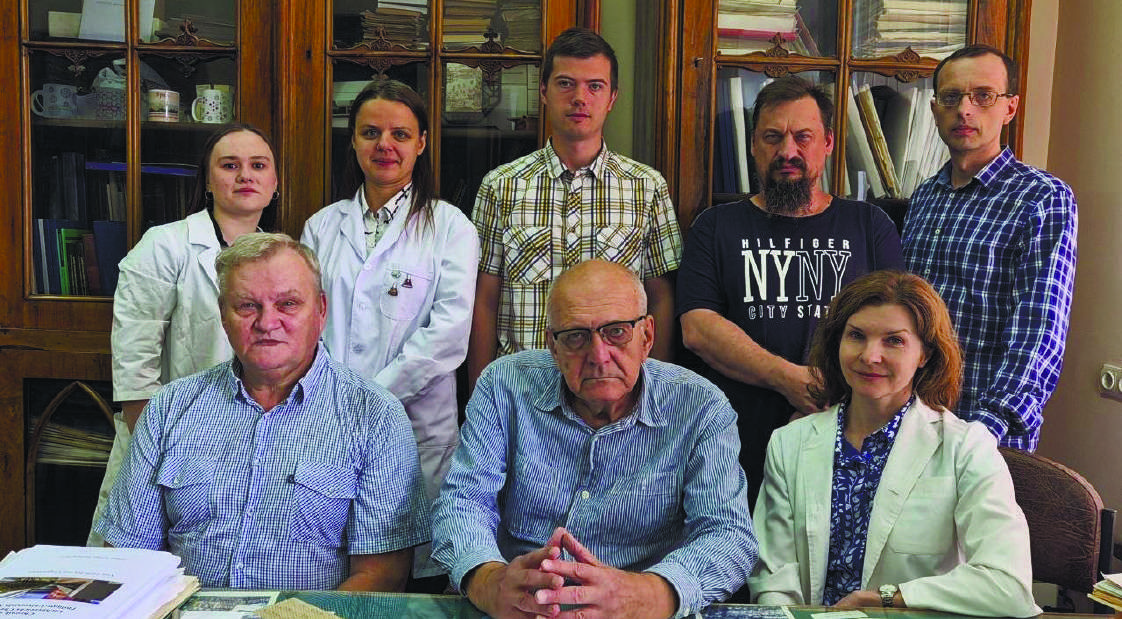
The project team includes Professor Nataliia Vodolazka; Associate Professors Oleksandr Lebid, Tetiana Cheipesh, Volodymyr Farafonov, Mykyta Marfunin and Daria Kharchenko, all PhDs of Sciences; Senior Research Fellow Serhii Shekhovtsov; and PhD student Vladyslav Haidar. The project is led by Mykola Mchedlov-Petrossyan, Academician of the National Academy of Sciences of Ukraine, Professor, Honoured Worker of Science and Technology of Ukraine, laureate of the State Prize of Ukraine in Science and Technology, and Head of the Department of Physical Chemistry and Chemical Materials Science at Karazin University.
Behind the project’s complex title lies an attempt to peer into the space where different “worlds” of matter meet and understand what happens at this invisible boundary. The fundamental knowledge gained may eventually find applications in the development of nanomaterials and catalysts, biomedical technologies, chemical analysis, supramolecular chemistry, and environmental nanoparticle monitoring.
We spoke with the project leader, Academician Mykola Mchedlov-Petrossyan, about why phase interfaces have become the focus of this new research, how molecular “scouts” help “read” the properties of an invisible environment, what fullerenes, carbon nanotubes and gas nanobubbles have in common, and why fundamental chemistry is already paving the way for future technologies.
Mykola Otarovych, why was this particular research area chosen?
Physical chemists know well that studying the interface between phases, for example, between a solid and a liquid, is one of the most challenging tasks.
Phase interfaces are present almost everywhere. The behaviour of molecules within this thin interfacial layer determines the efficiency of adsorbents and catalysts, the possibilities for developing new functional materials, and the course of certain biological processes.
The problem becomes even more complex when one of the phases is dispersed into particles much smaller than a micron. This occurs, for example, when compounds dissolved in water exist not as individual molecules but as large aggregates consisting of many thousands of molecules. Such systems are highly diverse and important to many areas of modern technology. The Japanese scientist Kozo Shinoda once described these solutions as “organized”, which is where the project gets its name. Despite decades of research, the nature of this environment remains insufficiently understood. We hope to obtain new, interesting and useful results.
How can we find out what happens in such a thin interfacial layer?
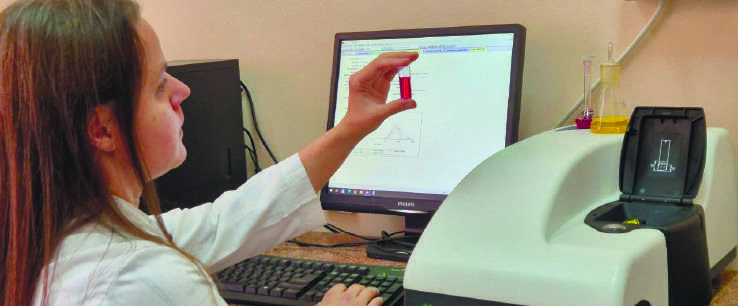
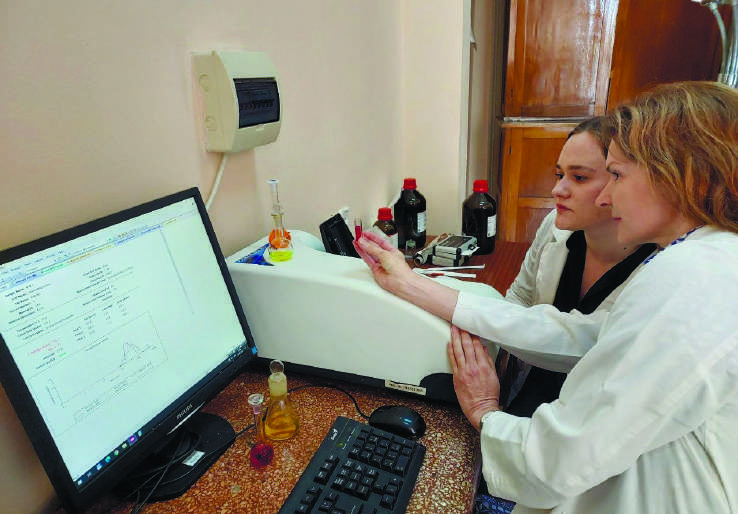
To do this, we have selected a range of specialised molecular “scouts”. These are organic dyes that respond with great sensitivity to their immediate surroundings. By changing colour, absorption spectra or fluorescence, they will provide information about the acidity and polarity of the environment, the strength of hydrogen bonds, and the electrical potential of the surface.
However, the research will go beyond laboratory experiments. Molecular dynamics simulations will be conducted in parallel. This modern computational modelling method makes it possible to track the movement of individual molecules over time.
Combining experiments with computer calculations will enable us to build as complete a picture as possible of the processes occurring at the water–nanoparticle interface.
What types of physicochemical systems will be studied?
The project will investigate a wide range of nanodispersed systems, including micellar solutions of surfactants, direct and reverse microemulsions, fullerenes and fullerenols, single-walled and multi-walled carbon nanotubes, and even gas nanobubbles. This diversity will help us establish general principles governing the behaviour of interfacial surfaces, regardless of the nature of the nanoparticles themselves.
Fundamental research with practical applications in the future?
Although this is a fundamental research project, its findings may be applied across many fields. The knowledge gained will help improve nanomaterial synthesis methods, support the development of new catalysts, and advance biomedical technologies, chemical analysis, and supramolecular chemistry. New fluorescent dyes may form the basis of highly sensitive molecular sensors, while findings on the surfaces of nanocarbon materials may contribute to the development of modern nanomedicine.
The project also has environmental significance. Increasing quantities of nanomaterials are entering the environment, yet their behaviour in natural waters remains insufficiently understood. The findings may represent an important step towards developing effective methods for monitoring nanoparticles in the environment.
What gives you confidence that the project will succeed, and what are your plans for the future?
The project builds on the team’s extensive experience and international recognition in physical chemistry of dispersed systems, molecular probes, and nanocarbon materials. In recent years, team members have published a number of papers in leading international journals ranked in the first quartile of global bibliometric rankings.
Support from the National Research Foundation of Ukraine provides an opportunity to significantly expand this research and gain new fundamental insights into the processes underlying many modern technologies.