


Accessibility as a Strategy for the Future: New Standards for Specialist Training Discussed at Karazin University
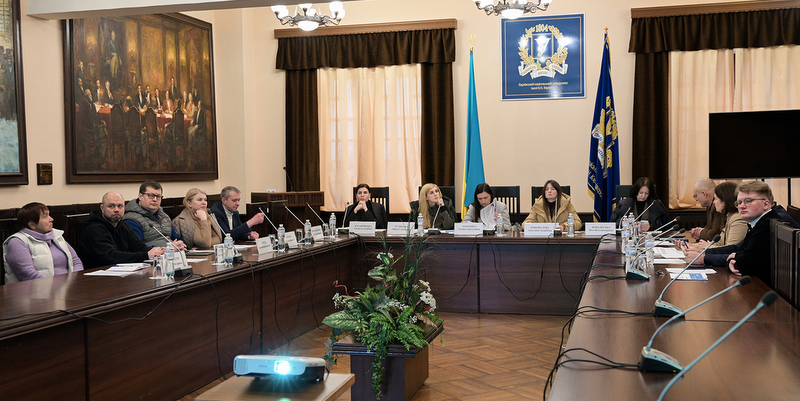
On 16 February 2026, V. N. Karazin Kharkiv National University served as a platform for discussing critically important issues related to the development of a barrier-free environment in Ukraine. Held in an offline format, the meeting brought together university leadership, representatives of public authorities, and leading experts to outline pathways for reforming education and healthcare in the context of inclusion.
The meeting was attended by distinguished guests: Tetyana Lomakina, Commissioner of the President of Ukraine for Accessibility; Iryna Tuliakova, Head of the Coordination Center for the Development of Family-Based Care and Child Care; Anastasiia Konovalova, Deputy Minister of Education and Science of Ukraine; and Vita Kovalska, Deputy Head of the Kharkiv Regional Military Administration.
Welcoming the participants, the Rector of the University, Tetyana Kaganovska, emphasized that accessibility for Karazin University is not only a requirement of the time but also a core value that calls for scientific substantiation and practical implementation.
In her presentation, Olena Muradian, Director of the Education and Research Institute of Sociology and Media Communications, compared educational programs for training specialists involved in accessibility issues. She addressed key topics, including the transformation of training standards in view of post-war recovery needs; cooperation between sociologists and lawyers in developing a model based on international experience and the values of inclusive societies; proposals to introduce a system of lifelong learning for social managers, incorporating dual education and targeted master’s programs; and collaboration with stakeholders in the development of educational programs.
The Dean of the School of Medicine II, Oleksandr Kozlov, delivered a report proposing the establishment of an Institute of Speech and Language Therapy at Karazin University. He outlined ways to address the staffing crisis in this field, noting: “We must move away from the outdated model where a speech therapist was solely a pedagogue. Today our patients are children, veterans, and military personnel with severe blast and mine-related injuries. This requires medical, psychological, and anatomical approaches.”
The outcome of the meeting will be the development of concrete recommendations to improve the legislative framework and educational programs in line with the needs of an inclusive society of the future.
.png)





%20(1).jpg)
.png)